3 Systems You Need for Your Baking Business
Jun 19, 2026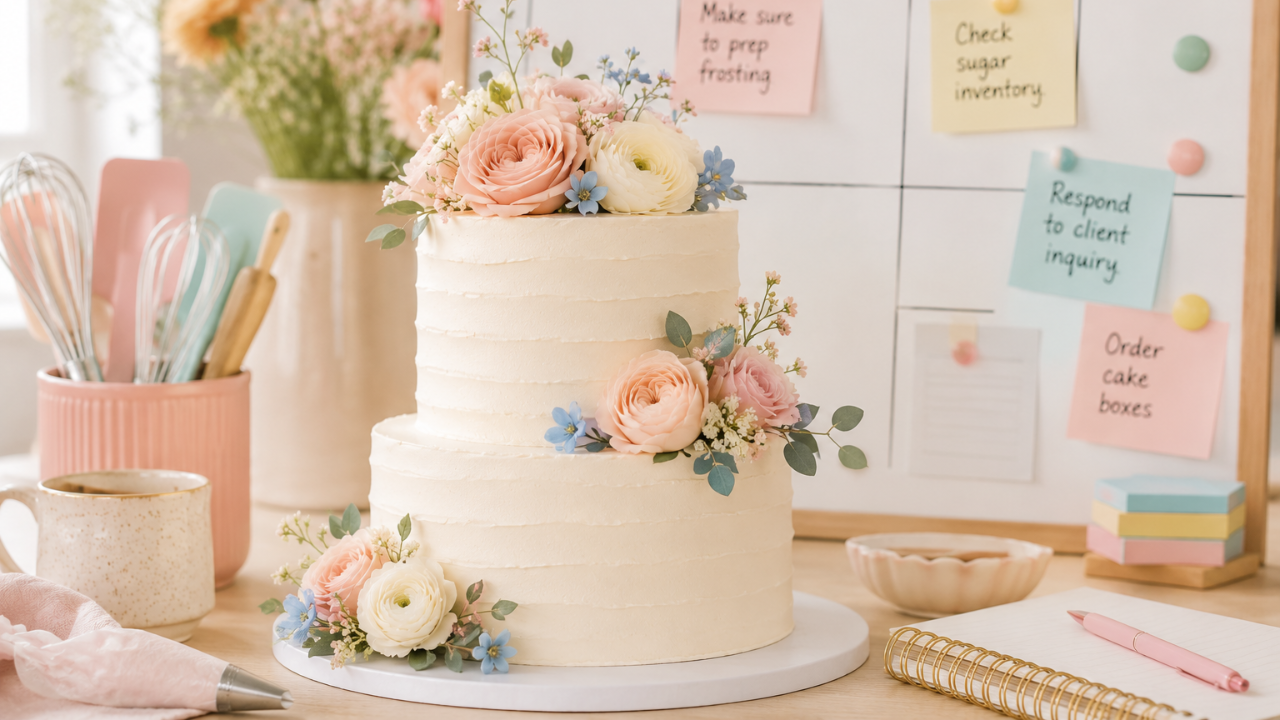
In June of 2020, I got an email from a bride about the flowers that were to be placed on her cake the next day. She was having trouble finding the right greenery, and was asking if I could help her to find it.
But I was really confused. I didn’t think I had an order for the next day…
However, a quick glance through my calendar and through my emails made my stomach drop, confirming that I did INDEED have a scheduled wedding order for the next day: a two-tier naked cake and 5 dozen lemon ginger cupcakes. And I hadn’t baked ANYTHING.
Luckily in this case, I was able to crank out that cake and cupcakes, even though it meant a late night followed by an early morning, and the bride was never aware that I almost completely missed her order.
It still makes me shudder a little.
So what should I have done differently so this order didn’t fall through the cracks? Let’s talk about three business systems that are essential to running your baking business successfully.
Why Systems Matter in Your Baking Business
Having systems in your business means you have set and defined processes that allow you to stay organized so you can still enjoy the creative process.
You need to have a system for tracking your orders, a system for managing your production processes, and a system for tracking your inventory.
There are lots of different ways to set up these systems and different tools to help you do so. The key is to find what works best for you!
1. Create a System to Keep Track of Baking Orders
The first system you need to explore and set up is how to keep track of your orders. This starts with where you accept orders. To keep life simple and clear for both you and your customers, pick one place to accept orders. This can be:
- A social media page
- Some kind of order form
This will allow you to keep all your orders in one place so that nothing gets forgotten. I lean heavily towards an order form as your ordering process.
- Let’s think back to your baking business plan and the policies and procedures you set for yourself. What is your weekly or monthly order capacity? Write it down so it’s in front of you. If you’re not sure yet what your exact capacity is, underestimate it a little and start small! You can expand it and work up to a higher capacity as you go, but you don’t want to overwhelm yourself too much too fast.
- Next you need to track orders that are pending, meaning you’ve made your response that you're available and you're just waiting for their reply.
- Next you need to track orders that are booked, meaning they are paid for in full or they’ve already put a deposit down.
It is so important to track your pending orders because it will prevent you from overbooking yourself.
Imagine you have five people request the same day in March for an order, but they all messaged at different points and you lost track of it all. But then they all respond at once and send payment and now you have five orders booked on the same day!
*Programs that help you with tracking orders:
- Bakediary
- Castiron
- Google Calendar
2. Create a System for Baking Production
You need to know what's coming up these next few weeks and the coming months so you can properly order ingredients, supplies, and begin baking!
Loooooots of things can be done ahead of time and I highly recommend this! Nothing will make you hate baking more than if you try to make the dough, roll and cut the cookies, bake and cool them, make the frosting, do the decorating, package them all up, and deliver…all in one day. It’s waaaaay too stressful and it's too hard on you mentally and physically!
Every recipe is different and will have its own unique expiration date. You’ll want to test your own recipes for quality and safety in storage! It’s best to do this on a test batch and NOT test it out on actual orders. Use down time as practice and research time!
Here are some other tips I’ve found for planning production:
- Typically cake layers can be baked, wrapped, and frozen for up to 3 weeks before the freshness starts to expire. (Note: this is quality issue, not necessarily a safety issue. It won’t kill someone to eat it after three weeks, but it might start to be a little more dry or a little less tasty.)
- Buttercream can be kept in the fridge for typically 5-7 days, and it can also be frozen for longer! Different buttercreams may store for shorter or longer periods of time. Also, the longer you store buttercream, the more the fat in the butter will start to oxidize. This means if you’ve already colored it, you might get a color slightly different than what you planned for, even if the buttercream hasn’t necessarily gone bad.
- Lots of fillings and decorations can be made ahead of time. Even boxes can be put together ahead of time! Here’s an example: You’re doing a Valentine’s Day sale and you sell 50 boxes of chocolate-covered strawberries. It takes you 60 seconds to put together and assemble just the box and packaging. That’s about an hour of time it’s going to take you just to get the boxes ready to put the strawberries in! So, do that ahead of time! It will save you so much stress on the day you are actually packing them up.
- Macaron shells can be made and frozen, depending on the recipe and the type. Most macarons need to rest and mature anyway!
3. Create a System for Keeping Track of Inventory and Supplies
There’s nothing worse than going to bake an order and realizing that you're out of sour cream, or dowels, or piping bags! Then you have to send your husband frantically to Hobby Lobby before they close in the next 5 minutes. I might be speaking from experience…
When you’re first starting out, you might not know how much butter you’re going to need for an 8-inch cake, or how fast you’ll run out of parchment paper and piping bags. This is part of the learning curve to observe your own production and learn from it, so that you can make estimates and keep your kitchen well stocked.
Don’t Be Afraid to Buy Extra Ingredients
It is SO good to overcome the fear of buying in bulk or buying an extra box of butter to help with the order. I know, I was there as a beginner baker trying to skimp on everything to maximize the money that stayed in my pocket on each order. But in reality, this was self-sabotage and it only made my life much harder. It was thinking short-term, like everything depends on this one order and how much money I make on it. Give yourself a buffer, give yourself some trust, and overestimate your supplies and ingredients a little so that you don’t have a 2am cry-by-the-oven night when you run out of buttercream and you’re out of sugar to make more!
Keeping production organized can be a mental chore, especially when you have so much going on.
The Best Baking Systems for ME
I worked in a commercial bakery years ago, and I learned a huge lesson there. Even though I was just a cookie dough mixer, I still use that bakery’s system to organize my baking business:
- I have a whiteboard that I put up in my kitchen.
- On it, I schedule space for upcoming monthly orders and projects.
- I schedule space for daily production.
- Based on that, I make my monthly business shopping list.
As you make and bake ahead of time, be sure you very clearly and specifically label things so that you know what it is, what it’s for, and when it was made.
Easier Said Than Done…Unless You Practice!
Staying on top of this will take discipline. You have to be your own boss and make yourself actually put in your work hours. After years of doing this, I now count it as the greatest act of self-love to keep the dishes done ahead of time and to get my baking done at the beginning of the week so that I don’t suffer later. I’ve been there a looooooot.
Be a good boss to yourself!!! Do your future self a favor and get things prepped ahead of time for that person. And the thing you have to realize is that if you’re not liking something about your schedule, your work, or your processes, YOU are the one with the control to CHANGE IT!
Find what works for you, develop good habits and discipline following through with it, and adjust as necessary. Just like you would any recipe.